Slovenia holidays
Everything you need to know about holidays in Slovenia
This is The Header Then

Planning Slovenia holidays – Prices in Slovenia

February 13th, 2010 . by admin

One of the most important questions about holidays is “How much is it going to cost?” If money is not a problem, you can just pack the bags and go on the road. However, most of us have to save money for travel and have to calculate the trip costs in order to know how much money we need for our holidays.  I’m writing this article to inform you about costs of some typical necessaries (Slovenia prices) in order to help you calculate costs of your Slovenia holidays.

Accommodation

When you arrive in Slovenia, your main concern will probably be to find a place to stay (if you haven’t reserve it in advance, which I recommend to do). The most expensive type of accommodation are hotels. Prices in more popular tourist resorts (Ljubljana, Bled, Postojna) start at 40€/night for single room (if you get a room at this price in high season you can be very happy) and can go very high in some fancy hotels. The average is about 60-80€/night for single room.

Another type of accommodation, especially in winter resorts, are apartments, which are usually 10 – 20 % cheaper than hotels. Some of them are run by local families, which are very friendly and you may also be able to negotiate the price (when you make reservations).

Hostels are more and more popular among travelers, not just the young ones. Prices of hostels are much lower than hotel prices. You can get a great price if you are willing to share room with other people. Prices for one night in shared rooms start at 8€.

Camps are another option. In main season (summer) camps charge around 12€/night for one person, children pay half of the price (price is for camps at seaside), which means that an average family (parents with two children) will pay around 40€/night.

One of the best types of accommodation in Slovenia are tourist farms. It is hard to compare prices of tourist farms with other types of accommodation, because tourist farms usually aren’t located near “hot spots”. The ones that are have higher prices, but an average price for staying at tourist farms is about 25€/night for one person, which includes breakfast. If you travel in a group (family, friends) and stay for more than two days, you can get really great prices (for example 35€/night for 4-bed room).

Driving

Rent a car prices in Slovenia start at 30€/day for smaller cars (such as Opel Corsa). Bigger cars are more expensive.

Public transport prices are a mystery for me too, because I never know how much am I going to pay:) For train prices in Slovenia look here.

Buses are faster, but more expensive than trains. Bus price also depends on the number of bus stops, which means that if bus stops 5 times on the way from Ljubljana to Maribor it will be more expensive than bus that stops 10 times. Usually buses with less stops drive on highway.

Prices of daily necessities

These are average prices. They can be higher in some tourist resorts or lower in some remote villages.

1 kilo of bread: from 1€ – 3€ (usually around 1.8€)
1 liter of petrol: 1.15€ (the same price on all filling stations)
Cup of coffe: 1.20€
Daily paper: 1€
½ liter of beer in a bar: 2.50€ (1€ in a supermarket)
2 dcl of cola in restaurant: 1.70€ (0.80€ in a supermarket)
Street snack: 2.50€ (hot dog), 2€ (pizza slice), 1.5€ (burek)
Large classic pizza in a restaurant: 5.50€
½ liter of water: 1€ (restaurant), 0.50€ (supermarket)
Souvenir T-shirt: 15€

Planning Slovenia holidays – Slovenia by car

January 17th, 2010 . by admin

In this article I would like to inform you about some important facts you must know if you are planning your holidays to Slovenia by car.

1.) Vignette

In 2008 Slovenia has changed its toll system. From 1.7.2008 vignettes must be placed on all vehicles driving on all highways in Slovenia and some other mayor roads (all tolled roads are recognizable by the warning with the picture of vignette).

Vignette warning

Vignettes are obligatory for vehicles up to 3,5t (maximum mass). Heavier vehicles are tolled normally at the toll stations and don’t need a vignette. When you see the toll station and you are in the vehicle with maximum mass under 3,5t and you have vignette placed on your windscreen, don’t panic. Go on the left lane, slow down (speed limit 40 km/h, I suggest you respect it because speed controls are common on toll stations) and drive through without stopping.

You can buy 1-year vignette (95€), 1-month vignette (30€) and 1-week (7 days) vignette (15€) for cars and vans or 1-year vignette (47.50€), 6-months vignette (25€) or 1-week vignette (7.5€) for motorcycles.

I know, it’s not cheap, but if you don’t want to buy it, I suggest staying away from the highways, because vignette controls are very often, especially on the toll stations and rest stations at the highways. Fines are from 300€ to 800€ if you get caught.

The only road you have to pay extra for (6.5€) is Tunel Karavanke (Karawanken tunnel). Tunel Karavanke links Slovenia and Austria and is about 7.8 km long. 

2.) Speed

Speed limits in Slovenia are comparable with other countries nearby. If the signs don’t say otherwise, speed limit on highway is 130 km/h, 90 km/h on open roads and 50 km/h in cities and villages.

Speeding in cities and villages can be expensive if you get caught (1 – 10 km/h more means 80€ fine, 11 -20 km/h too fast costs 250€, 21 – 30 km/h faster than speed limit means 500€ less on your vacations and so on …). Of course on open roads and highways fines are lower, but still high enough to cut your travel budget.

3.) Gas prices

In Slovenia gas price is defined by the government and is the same on all filling stations (except on automated stations, where gas is one or two eurocents cheaper per liter). So, if your main concern is the price it doesn’t matter where you fill your tank. Considering quality of gas, all gas providers must sell gas which meets European standards. Until this day, I haven’t noticed any difference between our major gas providers (Petrol, OMV, Agip, MOL), so I fill my tank in the nearest filling station after I see the warning light.  

Petrol, the biggest gas provider in Slovenia

4.) Parking

There aren’t many places in Slovenia that we could call unsafe so you don’t have to worry too much where you park your car. But, if your car isn’t parked like it should be (for example parking on sidewalks, too close to junction, …), you are bound to get a ticket or even worse your car can get towed away, which can cost quite some money. But, except in Ljubljana or at seaside, parking isn’t a problem in Slovenia (for example Bled and Postojna have quite many parking spaces available) and parking fees aren’t that expensive.

5.) Traffic jams

Slovenia, like other European countries, maintains its roads in summer because it is impossible to do that in winter. This can cause some problems on highways, especially on Saturdays (mostly because of tourist exchanges in Croatia). To avoid traffic jams in summer, travel at night and avoid weekends.

Because of many tourist driving to Croatia (they don’t know what they are missing in Slovenia:)), you can expect some waiting time on Slovenian-Croatian border (especially on Saturdays and on Sundays).

6.) Roads in winter

Roads in winter are usually cleaned quite fast and salted in order to avoid the risk of ice on the roads. Roads to ski centers are cleaned well, but tyre chains can save some troubles in case of heavier snow. Mountain passes are cleaned as well, but owing to unexpected snow tyre chains in your car equipment are obligatory. In the case of too much snow, mountain passes can be closed in the winter.

Mountain pass Vršič in winter

7.) Alcohol

Unprofessional drivers are allowed to have 0.24 mg of alcohol in one liter of exhaled air which is similar to 0.5g of alcohol in one liter of blood. Fines start at 450€. 

Planning Slovenia holidays – 5 Facts about Slovenia

December 29th, 2009 . by admin

I’m writing this article for people who don’t know much about Slovenia and are still deciding whether they should go to Slovenia. My suggestion is that you should go and I’m going to reason that with some facts speaking in favor of Slovenia.

1.) Location

Slovenia is a country in central Europe, bordering Italy to the west, the Adriatic Sea to the southwest, Croatia to the south and east, Hungary to the northeast and Austria to the north. But, in order to get a real idea where Slovenia is I’ve marked it on the map of Europe.
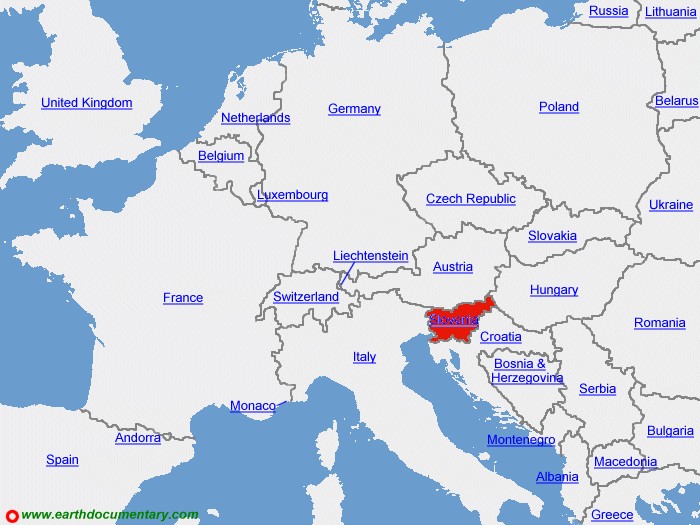
 

2.) Political aspect

The Republic of Slovenia has been an independent democratic republic since 1991, when Slovenia seceded from Yugoslavia. Unlike Serbia, Montenegro, Croatia and Bosnia, war in Slovenia only lasted for ten days (Yes, I said days not years:) and claimed nineteen victims (on Slovenian side). Slovenia has been a full member of European Union since 1.5.2004. One of Slovenia’s achievement is last few years is also Slovenian presidency of the EU council in the first half of the year 2008.

3.) Currency

When Slovenia was a part of Yugoslavia, our national currency was “Dinar”. Together with the independence we changed our currency – we were using “Slovenian Tolar”. But, when we joined European Union, our goal was to also join Monetary Union as soon as possible. As first country, which joined EU in 2004, we achieved our goal on 1.1.2007, when our currency became Euro (€). Now our national currency is Euro, which is a great advantage for you, because you won’t have to switch currencies all the time. 
 

4.) Economy

When Yugoslavia was falling apart, Slovenia was lucky from two perspectives. Firstly, war in Slovenia only lasted for 10 days, which means, if we ignore other facts, that Slovenia started its transition (from socialism to capitalism) without delay, which occurred in other Yugoslavia countries (because they were in war). The consequence is that Slovenia has already completed the transition and therefore our economy is more stable than economy of other former Yugoslavia countries.

Secondly, we were lucky because even in Yugoslavia, Slovenia was the most developed part of the country. However, Slovenia had quite many problems when we became independent, because our economy lost a big market for our products – all other Yugoslavian countries. That caused a smaller economy crisis in 1992/93, but the economy has recovered quickly, because we focused on the market of European Union. Of course, former Yugoslavian markets are still very important for our economy.
 

5.) Safety 

Slovenia is a small country with little political influence on mayor countries. Therefore Slovenia remains free of terrorist incidents. Overall crime rate in Slovenia is low, but, like in any other country, it can happen (if you are unlucky). I still suggest normal preventive measures, such as locking your car (which I consider normal) and use of “secure wallet” (under shirt wallet).

Weather in Slovenia: Three main climate zones of Slovenia

December 2nd, 2009 . by admin

Weather in Slovenia is not as simple as you might think considering the fact that Slovenia isn’t a big country. That is why I’m going to inform you about some aspects of weather that might help you while traveling.

First of all, mostly because of landscape variety, weather is different in different landscapes of Slovenia, which means that seaside has different climate than only 30 km distant Karst. And of course, Karst has different climate that 60 km distant Ljubljana. And so on. So I will describe each climate separately. 

Mediterranean climate in the West

Mediterranean climate is typical of Primorska region, the region including the seaside and practically all the western part of Slovenia. It has very hot summers and mild winters. The main problem of this climate is a short-term but very strong wind called “burja”, blowing up to 100 km/h. It can blow all over the year, but most commonly blows in winter (so don’t worry if you are planning Slovenia holidays in summer). Snow isn’t very common in areas with Mediterranean climate (especially not at the seaside).

Continental climate in central and eastern Slovenia

Typical of continental climate are hot summers and cold winters. Because of proximity to mountains, central Slovenia has much more rainfall than eastern Slovenia (1300 mm in Ljubljana vs. 800 mm in Murska Sobota). Most precipitation falls in spring and autumn. In wintertime snow is common. In summers rain showers can surprise you in the afternoon. Unfortunately, hail is getting more and more common.

Severe alpine climate in mountain regions

In Slovenian mountains weather can cause you many problems. Typical of alpine climate in Slovenia are very cold winters and cool summers. A lot of snow falls in winter, and in some areas snow remains until the next winter. Despite climate changes, Slovenia still has its own glacier. In summer, rain is frequent and can be quite strong.  

Conclusion

When planning your Slovenia holidays it is very important to look the weather forecast and select suitable clothes, appropriate for the area you are planning to visit. Although Slovenia isn’t like England (it doesn’t rain all the time), umbrella might be useful because when it rains it usually rains heavily. Because of the wind, wind jacket can also be useful. Do not forget to take your hiking shoes if you are planning to visit Slovenian mountains, because the rain there is more frequent and paths can be slippery.

Technorati Tags:

Slovenia holidays – Journey to Slovenia

November 7th, 2009 . by admin

Slovenia is reachable by car, motorcycle, train, bus or plane. Well, if you are fan of challenges, Slovenia can also be reachable by foot. And for sea lovers, Slovenia is also connected with world by sea.

My personal opinion and experience is that when you are in Slovenia, you must have a car or a motorcycle. It may be your own, if you visit Slovenia by car or motorcycle, but if you visit Slovenia by any other means of transport, I recommend renting one (if you didn’t arrive by motorcycle, you will probably want to rent a car).

Visiting Slovenia by car

From that point of view, if you are coming from nearby countries, the best way to organize your Slovenia holidays is travel to Slovenia by car. Slovenia has, in past few years, built a brand new motorway network. You may say that you hate traveling by car because of traffic jams. If you don’t arrive in Slovenia on Saturdays (in summer, otherwise day isn’t important), you most likely won’t have difficulties with too much traffic on our roads. From year 2008 we also have new motorway toll method – vignettes for personal vehicle up to 3,5t. You have three options – 7 day vignette for 15€, monthly vignette for 30€ or annual vignette for 95€ (prices are for personal vehicles – cars and most of vans; prices are lower for motorcycles).

Visiting Slovenia by train

Slovenia also has national rail network. Arriving to Slovenia by train may be a good option, but travel in Slovenia by train isn’t a good decision. Because of landscape variety, Slovenian trains are slow and it will take too long to get anywhere. Besides, you will miss beautiful sights on the way. So, even though you came to Slovenia by train, I suggest traveling in Slovenia by car.

Visiting Slovenia by airplane

If your home is far away from Slovenia, you will probably visit Slovenia by plane. Slovenia has two larger airports (well, in comparison to other European airports, both are very small). One is near Ljubljana (Letališče Jožeta Pučnika) and other near Maribor (Letališče Edvarda Rusjana). You have three major airline companies flying to Slovenia. Slovenian national airline is Adria Airways. Easy Jet flies from London to Ljubljana and Ryan Air flies from many European cities to Graz, Klagenfurt (Austria) or Venice (Italy) – all these are near Slovenia (Graz and Klagenfurt less than an hour, Venice about three hours). When you will arrive to Slovenia, you will probably want to rent a car – please reserve it before you go on a trip in order to save some money on the trip.

Visiting Slovenia by bus

Bus can be a good option if you are traveling to Slovenia with an organized group. If you are traveling alone, train is a better option (cheaper, faster). When you are traveling by bus, together with a group, you have much less travel worries – but, also much less freedom. The choice is yours.

Travel to Slovenia by sea

There is a direct cruise line between Venice and Slovenia, driving from April to October.